No Native Integration? No Problem.
If It Has an API, We Connect It
Your industry software, your CRM, your payment system, your AI tools — talking to each other in real time with proper error handling. We build custom API and webhook integrations that survive production, not weekend-project scripts that fail silently.
Does Any of This Sound Familiar?
When your critical tool 'doesn't integrate,' every one of these becomes daily reality.
Humans Are Your Integration Layer
Staff re-typing data between your industry software and everything else — slow, error-prone, and soul-crushing for everyone involved.
Zapier Says 'App Not Supported'
Your LOS, AMS, EHR-adjacent tool, or proprietary system isn't in any middleware catalog — so the most important data you have stays siloed.
The Last Script Broke and Nobody Knows Why
Someone's cousin wrote a connector in 2023. It fails silently, there are no logs, and the person who understood it is gone.
Polling Delays Kill Time-Sensitive Flows
Your 15-minute Zapier polling means speed-to-lead automations start late and mid-call AI lookups are impossible.
There’s a better way. Here’s what we built for businesses like yours.
How API Integration Works — From Audit to Monitored Sync
Completely done for you. You don’t need to be technical. We handle every step.
Free Integration Audit
We map the systems, the data flows needed, and each API's real capabilities.
Architecture Design
Direct API, webhooks, or middleware — chosen per connection with run-cost math.
Build
Auth, field mapping, transformations, and business logic implemented.
Hardening
Retry logic, idempotency, rate-limit handling, and failure alerting — the production layer.
Deploy + Monitor
Live with logging and alerts; 30 days of post-launch support included.
Your API Integration Build — Everything Included
No tools to buy. No developers to manage. One complete done-for-you build.
The difference between a script and an integration is everything that happens when things go wrong. We build for the wrong days.
Integration Builds We Deliver
CRM Integrations
GoHighLevel, HubSpot, Salesforce, and industry CRMs synced with your operational tools.
Payments & Billing
Stripe, Square, and invoicing systems driving automation on every revenue event.
Industry Software
LOS, AMS, FSM, booking platforms — the vertical tools no middleware supports.
AI Integrations
Claude/GPT pipelines: scoring, extraction, drafting — plus voice-agent backends for mid-call lookups.
Data & Reporting
Warehouses, sheets, and dashboards fed by scheduled or real-time syncs.
Webhook Infrastructure
Real-time event flows where polling is too slow — speed-to-lead and live AI use cases.
Why Choose AutomateX360 for API Integration?
- 200+ integrations delivered across CRM, payments, and vertical software
- 4.9/5 rating across 47 verified reviews on Upwork and Fiverr
- Production engineering standard: retries, idempotency, alerting
- Honest architecture: middleware when it's cheaper, custom when it's better
- AI-integration depth — including real-time voice agent backends
- Documentation your future developers will thank you for
Custom API vs Middleware — How We Choose Per Connection
Ideology is expensive. We pick the right tool per connection and show the math.
- Fast to build, cheap to run
- Visual flows your team can read
- Thousands of pre-built app modules
- We add error handling most builds skip
- Best at moderate volumes
- True real-time via webhooks
- Any system with an API — no catalog limits
- Complex logic & transformations
- High volume without per-task fees
- Full control, fully documented
Most stacks end up hybrid: middleware for the easy 80%, custom builds for the hard 20% that matters most. The audit maps yours.
Real Clients. Real Results.
Watch what clients say after their system goes live — in their own words.


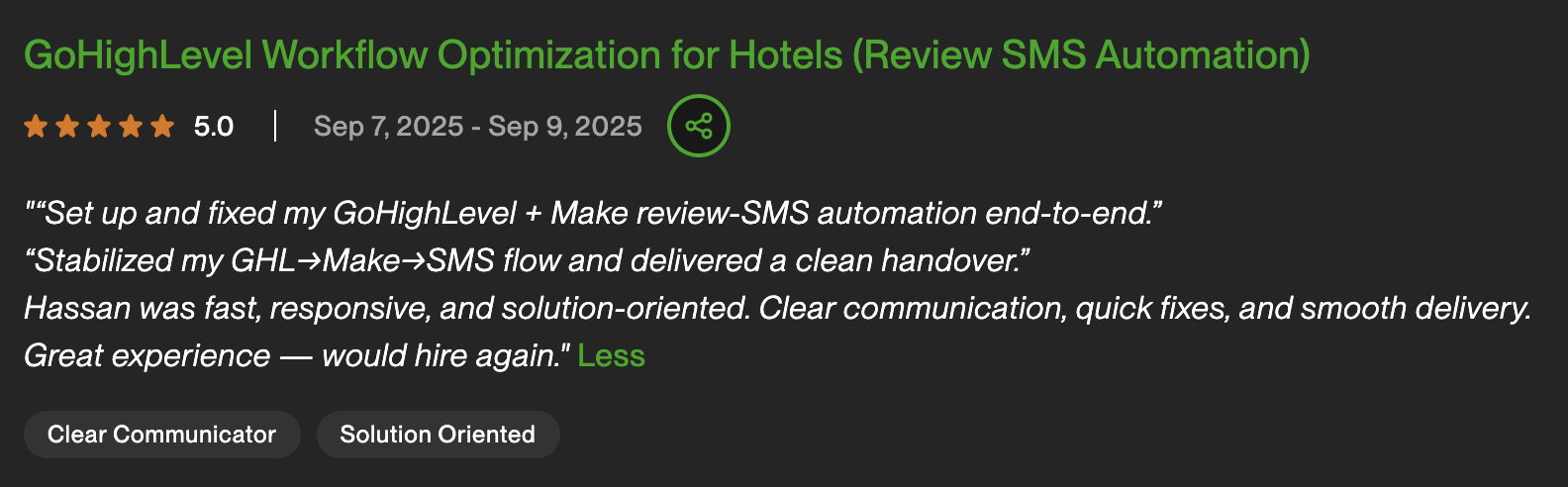
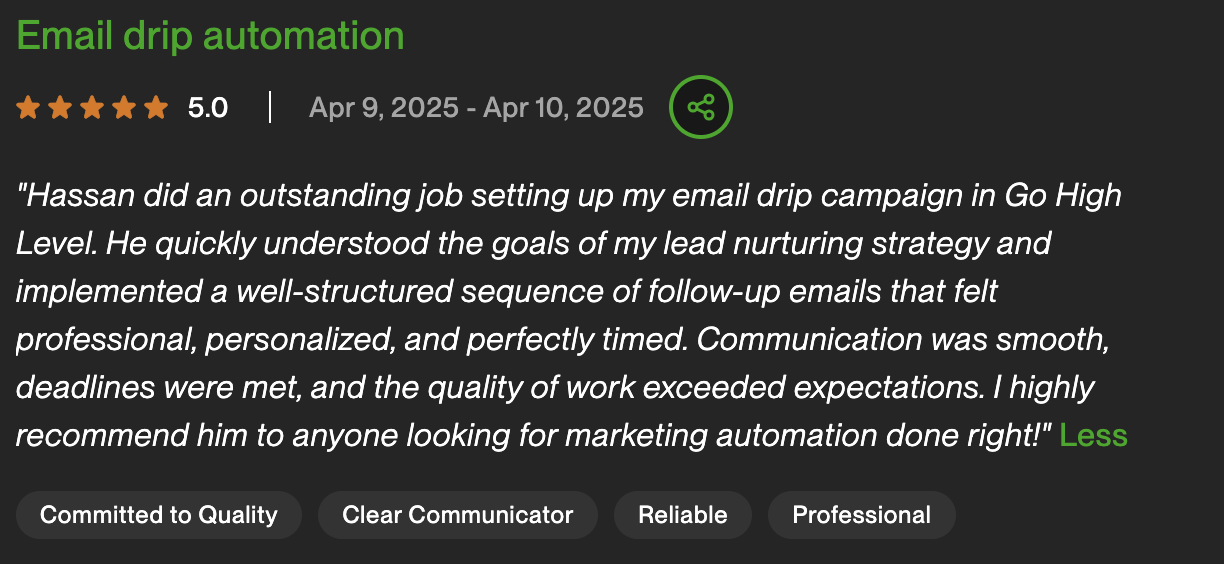
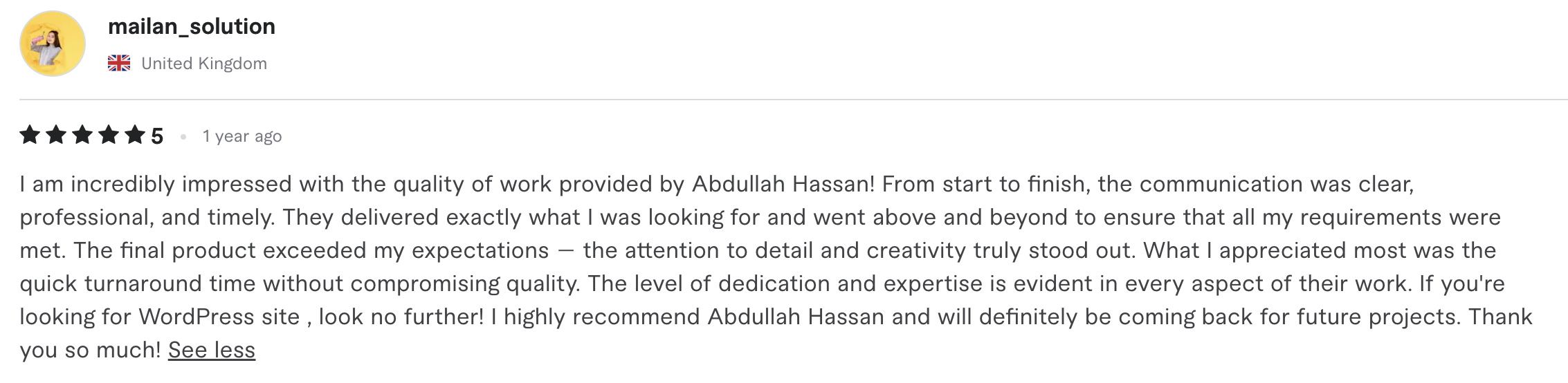
What Clients Say
Real reviews from real clients — verified on Upwork & Fiverr






Production Integration vs the Quick Script
Anyone can call an API once. Reliability under failure is the actual product.
| DIY Yourself | Generic Freelancer | Best Choice AutomateX360 |
|
|---|---|---|---|
| When an API hiccups | Data silently lost | Data silently lost | Retry with backoff |
| When it hard-fails | You find out weeks later | No alerting built | Instant alert with context |
| Duplicate events | Double records | Not considered | Idempotency keys |
| Rate limits | Random breakage | Discovered in prod | Throttling designed in |
| Documentation | None | A chat thread | Architecture docs |
| Handoff-ability | Rewrite it | Rewrite it | Any dev can maintain |
| Real-time capability | Polling delays | Polling delays | Webhook-native |
Vertical Systems We've Integrated
Every build is fully customized — flows, qualifiers, and tone tailored to your industry. Not a generic template.
Don’t see your industry? We’ve worked in 20+ verticals. Book a free audit — we’ll tell you if this is the right fit.
API Integration FAQ — Common Questions Answered
What is API integration, in plain terms?
Making two software systems exchange data automatically — a new sale in system A instantly creating the right records and triggering the right actions in system B — through their programming interfaces, instead of a human copying data between screens.
Our software isn't supported by Zapier. Can you still connect it?
Almost certainly — that's the core of what we do. If the system exposes any API or webhook capability (most vertical software does, even when undocumented in marketing pages), we build against it directly. The audit verifies capability before you commit.
What's the difference between webhooks and API polling?
Polling asks 'anything new?' every few minutes — cheap but delayed. Webhooks push events instantly the moment they happen — essential for speed-to-lead automation and mid-call AI lookups. We use webhooks wherever the platform supports them.
Can you build two-way syncs without creating duplicates or loops?
Yes — that's precisely what idempotency keys, conflict rules ('which system wins per field'), and change-source tracking are for. Two-way sync done casually creates loops; done with engineering discipline it keeps both systems truthful.
What happens when an integration breaks?
Transient errors retry automatically with backoff. Hard failures alert us immediately with full event context, and the failed events queue for replay — so a provider outage becomes a delay, not data loss. Every build includes 30 days of support; monitoring can continue beyond.
Can you integrate AI models into our workflows?
Yes — Claude and GPT-class models wired into real pipelines: lead scoring written back to your CRM, document extraction, draft generation with approval steps, and the real-time backends that let AI voice agents look up and write data mid-call.
How much does custom API integration cost?
Scoped per connection on the free audit — simple webhook flows are days of work; complex two-way syncs with vertical software are more. We quote fixed fees with monthly run costs projected, and recommend middleware instead wherever it's honestly cheaper.
Who owns the integration after you build it?
You do — code, credentials architecture, and documentation. Builds are documented so any competent developer can maintain them; you're never locked to us.
Start With a Free Audit — Zero Risk, Zero Commitment
We show you exactly what your system would look like before you commit to building it.

Not a sales rep. Not an account manager. The person who personally built 100+ AI systems reviews every audit request and runs the call himself.
What happens on the free audit call (45 min):
- We map your systems and the data flows you need — and verify each API's real capabilities (15 min)
- We show you comparable integration architectures, including the error-handling layer (15 min)
- You get a connection-by-connection plan with fixed costs — yours to keep either way (15 min)
Your Systems Should Work as One System
Every manual data hop is a defect and a delay. If it has an API, it can be automated — book the free audit and see your integration map.
Book Free Integration Audit